A Northern Lights tour is a guided excursion designed to take you away from light pollution and into the best possible conditions for seeing the Aurora Borealis. Tours typically run in the evening and at night, led by a local expert who monitors weather, cloud cover, and solar activity in real time. In Finnish Lapland, these tours operate from late August through mid-April, when the Arctic nights are dark enough for auroras to appear.
Waiting in the wrong place is costing you your best chance to see the Aurora
Many travellers assume the Northern Lights will simply appear outside their hotel window. In reality, light pollution, cloud cover, and being in the wrong location at the wrong moment are the most common reasons people leave Lapland without seeing the Aurora Borealis. A good Northern Lights tour takes you to dark, open terrain where the sky is wide and unobstructed. The guide tracks conditions in real time and moves the group if clouds roll in. That flexibility is the difference between a clear view and a blank sky.
Going out unprepared for Arctic temperatures is a serious risk
Standing still outdoors in Finnish Lapland at night in winter means temperatures that can drop well below freezing, sometimes reaching minus 20 to minus 30 degrees Celsius. Travellers who head out without the right clothing often cut their time outside short, missing the window when the lights appear. A proper Aurora Borealis tour includes thermal gear if needed, a warm place to return to, and a guide who knows how to keep the group comfortable while waiting. Preparation is not optional here.
What is a Northern Lights tour?
A Northern Lights tour is a guided night excursion that takes small groups into dark, open areas of the Arctic to observe the Aurora Borealis. It includes transportation from your accommodation, expert guidance on where and when to look, and typically a warm drink or shelter while you wait. Tours run from late August to mid-April in Finnish Lapland.
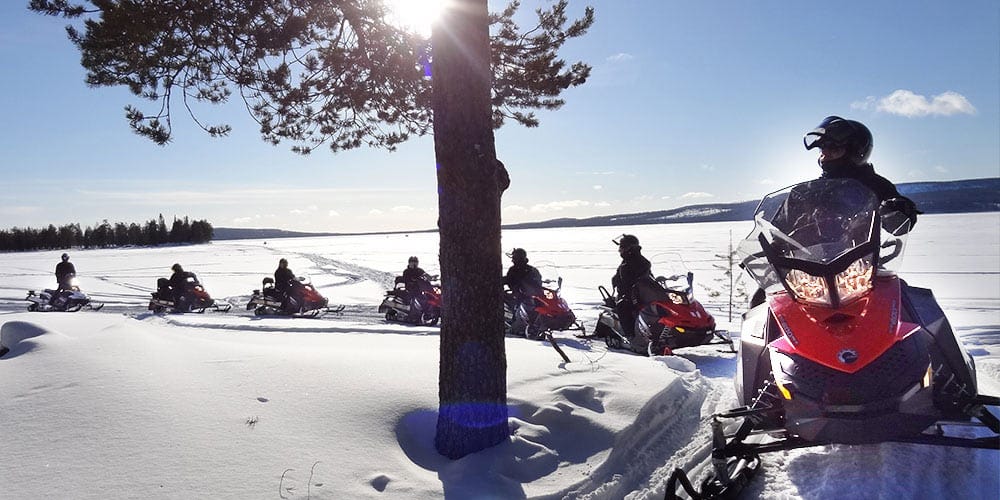
The format varies depending on the operator and your preferences. Some Northern Lights safaris in Lapland are conducted on foot, while others are by snowmobile or reindeer sleigh. What they share is the same core purpose: getting you to the right place at the right time, with someone who understands the conditions and can adapt on the go.
We run our Northern Lights tours in small groups, which means quieter surroundings, more personal attention from your guide, and the kind of stillness that makes the experience feel genuinely wild rather than like a packaged excursion.
How does a Northern Lights tour work?
A Northern Lights tour works by combining local knowledge, real-time weather monitoring, and mobility to put you in the best possible position to see the Aurora. Your guide picks you up after dark, drives to a location away from town lights, and monitors conditions throughout the evening. If clouds block the view, a good guide moves the group to find a clearer sky.
Here is how a typical tour evening unfolds:
- Pickup from your accommodation after dark, usually between 8 and 10 pm
- Drive to a pre-selected dark-sky location outside Rovaniemi or in the surrounding area
- The guide monitors the KP index (solar activity) and cloud cover in real time
- The group waits in a sheltered spot with warm drinks while the guide watches the sky
- When the Aurora appears, the guide positions everyone for the best view and helps with photography
- Return to your accommodation, typically by midnight or later depending on activity
The whole experience lasts roughly two to four hours. The guide’s role is not just to drive you somewhere dark. A skilled guide reads the sky, adjusts the location if needed, and helps you understand what you are seeing when the lights do appear.
When is the best time to see the Northern Lights?
The best time to see the Northern Lights in Finnish Lapland is between late September and early March, when nights are longest and darkest. The Aurora Borealis is technically visible from late August through mid-April, but the equinox periods in September and March tend to produce stronger geomagnetic activity, increasing the chances of a sighting. If you are considering seeing the northern lights in autumn, the September equinox period is particularly worth targeting.
Within any given night, the Aurora is most active between 10 pm and 2 am local time, though it can appear earlier or later. Cloud cover is the biggest practical obstacle, which is why flexibility in your travel dates and a guide who can move to clearer skies matter more than picking a specific calendar date.
If you are planning a trip specifically to see the Northern Lights in Rovaniemi or elsewhere in Lapland, staying for at least three nights gives you a meaningful chance of catching a clear night. One night is rarely enough.
What should you wear and bring on a Northern Lights tour?
For a Northern Lights tour in Finnish Lapland, you need thermal base layers, a warm mid-layer, a windproof and waterproof outer jacket, insulated trousers, thick wool or thermal socks, warm boots rated for sub-zero temperatures, a hat that covers your ears, and gloves or mittens. Thermal underwear is not optional in winter conditions.
Many tour operators, including us, provide full thermal overalls and boots for guests who do not have suitable gear. If you are unsure whether your own clothing is warm enough for standing still in minus 15 to minus 25 degree temperatures, accept the provided gear. Moving around generates warmth, but waiting for the Aurora means standing still for extended periods.
Bring your camera if you want to photograph the lights. A tripod and a wide-angle lens set to manual focus work best for Aurora photography. Your guide can help with basic camera settings on the night. A fully charged phone is useful for light pollution apps and checking the KP index, though screens should be kept dim to preserve your night vision.
What are the chances of actually seeing the Northern Lights?
The chances of seeing the Northern Lights on any given night in Lapland depend on three factors: solar activity, cloud cover, and how far you are from light pollution. With clear skies and moderate solar activity, the Aurora is visible on a significant proportion of nights in Lapland during the season. No operator can guarantee a sighting, but going out on multiple nights increases your odds substantially.
Solar activity follows roughly an 11-year cycle, and we are currently in a period of increasing activity, which means more frequent and more intense auroras than in previous years. Cloud cover is the more immediate variable and the harder one to control. That is why a guide who actively monitors the weather and moves the group if needed is more valuable than simply being in a dark location.
Industry experience suggests that guests who go out on three or more nights during a Lapland trip see the Aurora on at least one of those nights in the majority of cases, assuming they are travelling during the core season. No guarantee is possible, but persistence combined with good guidance significantly improves your chances.
Why is a guided Northern Lights tour better than going alone?
A guided Northern Lights tour is better than going alone because a local guide has real-time access to cloud cover data, knows which locations offer the clearest and darkest skies on a given night, and can drive to a better spot if conditions change. Going alone means committing to one location without the flexibility or local knowledge to respond to shifting weather.
Beyond logistics, a guide adds genuine value during the experience itself. They can explain what you are seeing, help you photograph it, and manage the practical side of keeping the group warm and safe in Arctic conditions. Solo travellers often underestimate how quickly the cold affects focus and comfort when standing still in open terrain at night.
There is also a safety consideration. Driving on icy roads in rural Lapland at night in winter is not the same as driving in more temperate conditions. A local guide knows the roads, the weather patterns, and the terrain. For most visitors, that local knowledge is simply not something they can replicate by renting a car and heading out with a phone app.